Choosing a Top Course for a Maine Camp Road: What the DEP Manual Says About Each Material
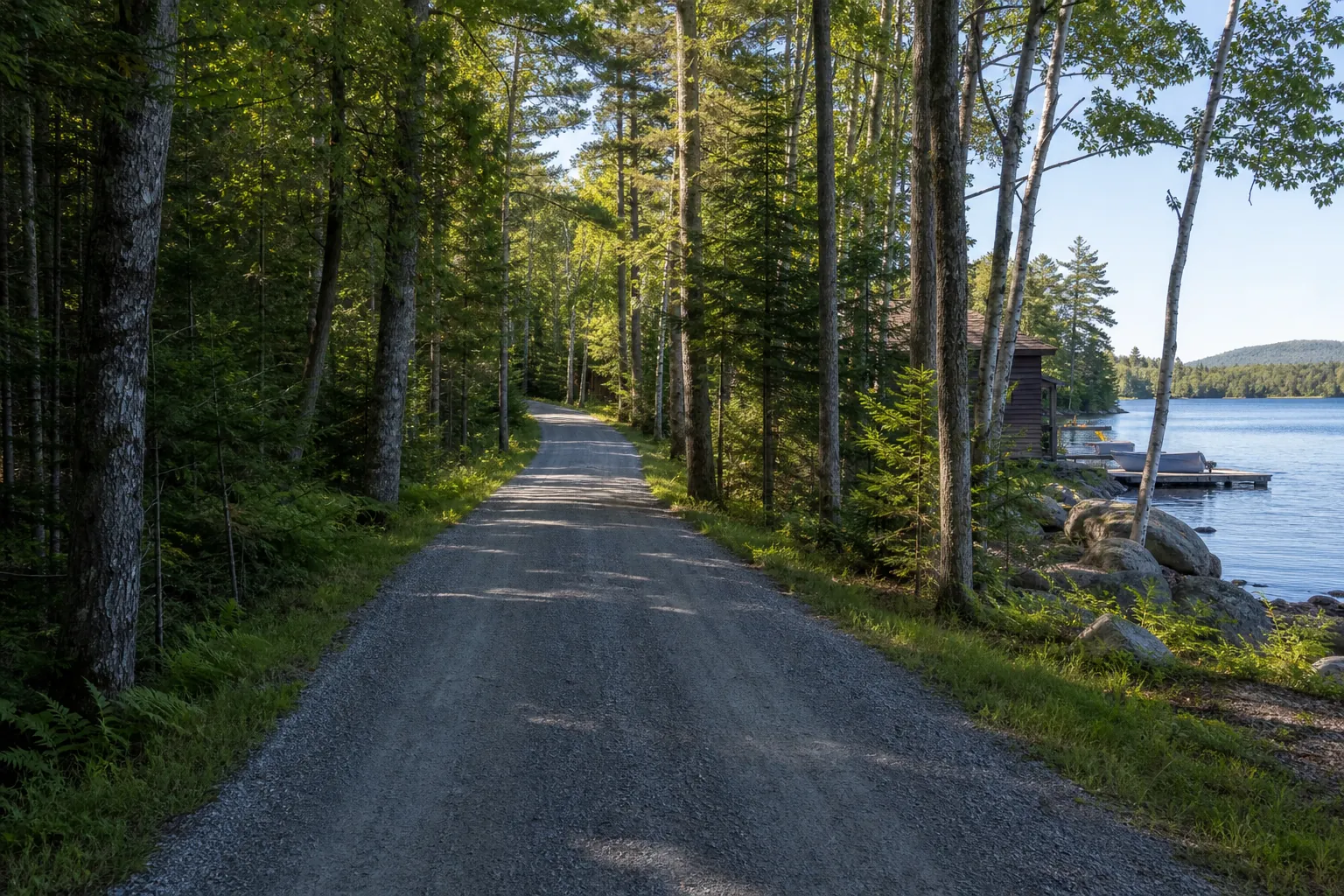
The top course on a camp road has one job that matters more than looks: it has to pack hard enough to shed rain, or the road ends up in the lake a little at a time. Before the road association spends a year of dues on new material, it pays to know which surface will stay where you put it. The Maine Department of Environmental Protection's Gravel Road Maintenance Manual, written for landowners on camp roads and revised by DEP in 2010, compares the usual choices in plain terms.
What a camp road top course has to do
The manual describes a good road bed as two layers. The base gives strength and drains freely. The surface on top has to be "strong and dense, shedding rainfall and preventing it from infiltrating into the bed." That second job is the one people forget. A top course that lets water through softens the base under it, and a soft base ruts.
To pack and shed water, the manual's surface gravel is well graded, with most of the stone smaller than 1/2 inch, nothing over 2 inches, and 7 to 12 percent fines (silt and clay). The fines fill the gaps between the stones and hold them together. It calls for a surface layer about 4 to 6 inches thick once compacted.
The lake is the reason the manual exists. It calls soil erosion "the single largest pollutant (by volume) to our surface waters" and traces many of the sediment problems in lake watersheds to camp roads that were badly built or badly maintained. Soil washed into a lake carries phosphorus, which feeds algae blooms. Every choice below is partly a choice about how much of your road ends up in the water.
Crushed gravel: why it packs and holds a crown
Crushed gravel is the manual's default, and its advice is blunt: "Be sure to buy crushed gravel, rather than bank run gravel, since the crushed material has edges that can lie flat and pack well." A mix of sizes locks together. Stone that is all one size moves around and ruts.
Names are not consistent from pit to pit, and the manual warns about that too: make sure what you order matches the description you need, not just the name. You can ask the pit to document the percent fines and the size range. You can also check a load with the manual's jar test. Half fill a clear jar with the material, top it up with water, shake it and let it settle. The fines settle last and form the top layer, so divide that layer's height by the height of the whole sample for a rough percentage.
The 3/4 inch driveway gravel on this site is listed as crushed stone in a graded mix of sizes that gets denser as it is compacted. If your association is matching the manual's surface numbers, ask for the gradation before you order.
Shape matters as much as material. The manual's rule for level or gently sloping roads is 1/2 inch of crown per foot of road width, which puts the center of a 12-foot road 3 inches above the edges. Steeper sections may need 3/4 inch per foot. The manual does not recommend going past that, because the road gets hard to maintain and hard to drive over. Crushed gravel holds that shape. Loose, rounded material does not.
Crushed concrete and reclaim as blends
Reclaim is ground-up old pavement, and mixed with fines it is known as "brown pack." Once compacted, the leftover asphalt and the fines bind into what the manual calls "a very resistant road surface." It works best on long, gradual slopes that keep losing their surface. It also helps on short steep hills, sharp turns and intersections, as long as nobody spins tires there.
The manual's tips for reclaim are specific:
- Place it about 3 to 4 inches deep. Layers under 2 inches tend to erode.
- On a problem slope, start just past the crest and work down.
- Compact it, preferably with a roller, or with several passes of a loaded pickup over the whole surface.
- Check the load. Waste mixed in, such as sheet rock, makes reclaim dusty and less likely to bind.
The manual reports reclaim lasting up to 10 years on seasonal roads. If you ever regrade it, compact it again so asphalt fines do not wash into nearby water. Many paving suppliers produce it, and the manual says mix quality varies greatly.
Recycled concrete gets a shorter entry, and not under that name. The closest heading in the manual's notes is "crushed cement," which it says "can work well and stay in place well if it's added to a road surface that's already crowned." It can be blended with crushed gravel, the note adds, and it can get dusty. The recycled crushed concrete sold here is 3/4 inch angular pieces blended with fines. Its product page treats it mainly as a base, and says it can be left exposed for travel or covered with driveway gravel. On a camp road, follow the manual's one condition and crown the road before it goes on, and expect some dust in a dry spell.
Rounded gravel and clean stone on the surface
Bank run gravel, as the manual describes it, is rounded. "Tires can easily roll the rounded bank run gravel stones out of the road surface, leaving holes that start ponding and pothole problems."
Clean crushed stone fails for the opposite reason. It is angular, but it is "uniform in size and without fines," so it "doesn't pack well and moves around a lot under tires." The manual keeps it for road base and for stabilizing soft, flat parking areas. Stone dust packs very well and can work as a surface coat on a driveway, but it can turn muddy in spring because water does not drain through it.
Dust, fines and sediment near a lake
Dust is your road's fines leaving. The manual says a gravel road can lose as much as 1/2 inch of surface material a year to dusting. Over a mile of 12-foot road, that comes to about 100 cubic yards. Fewer fines means looser gravel, more washboarding and worse traction.
Calcium chloride is the manual's recommended dust treatment, spread on a moist, scarified surface, then raked or graded in and compacted. The same page says chemical treatments, "even salt," must be limited or not used at all near water wells and in the shoreland zone. On a lakefront road, that can rule out the easy fix.
Grading is the other sediment source. A freshly graded surface has to be compacted before the next rain, the manual says, so the fines lock in with the coarser stone instead of washing off, and ordinary cars driving over it do not compact it enough. Steel tine rakes loosen fines too, and the manual says they can do more harm than good unless the surface is compacted afterward.
Under Maine's shoreland zoning law, shoreland reaches 250 feet back from the normal high-water line of a great pond. The manual says routine maintenance of an existing road generally needs no town permit, but filling, disturbing soil or widening may. Call the code enforcement officer before that kind of work.
When the base needs fixing before a new top course
New surface gravel will not cure a bad base. The manual lists the usual causes of rutting on soft roads: base material that does not drain, a road built so low that its base sits in the water table, too thin a base, and ditches that cannot drain it. Refilling the same washout every year, it says, "is a waste of money."
The manual's base is coarser than the surface course and holds few fines, so water drains through it. It should be 12 to 18 inches thick when compacted, and the manual points to MaineDOT's Type A base aggregate (specification 703.06) as an equivalent. Type A gravel on this site is listed as 3/4 inch minus: crushed stone and gravel in a range of sizes, bound together by its own fines. If a plan calls for 703.06 Type A by name, ask for the gradation. On a soft road, the manual also describes laying woven geotextile over the graded, crowned road and covering it with at least 6 inches of compacted surface material.
To size an order, the manual works through a road 150 feet long and 12 feet wide at 3 inches: 16.6 cubic yards, times 1.11 for compaction, or about 18.5 cubic yards to order. The gravel calculator turns your own measurements into tons. A dump truck tips its whole load in one pile, so on a narrow camp road pick a firm spot where a loader can work from it. The delivery checklist wants a 12-foot-wide way in, with branches and wires kept out of it, which on some camp roads means a morning with a pole saw first.
Walk the road in mud season before the association votes on anything. If it ruts every spring, put this year's money into the base and the ditches and let the top course wait. If it holds its shape, the manual's answer is 4 to 6 inches of compacted crushed gravel with enough fines to pack, with reclaim kept for the slopes that keep washing out.